

MENIFA’s educational approach and long-standing work with at-risk and disconnected youth were recently featured in the Israeli weekly B’Sheva. The article profiles MENIFA founder and CEO Etia Dan and explores the philosophy behind the organization’s work: seeing the whole child, understanding the challenges behind school dropout and disengagement, and providing individualized educational, emotional, and therapeutic support. Through stories from more than two decades of work in the field, the article highlights MENIFA’s belief that meaningful relationships, attentive listening, and the presence of a committed adult can help young people rebuild trust, strengthen resilience, and find their way forward.
Below is the English translation of the article.
Read the full original article in B’Sheva here:https://be7.co.il/26613
It is a summer day at the beginning of the school vacation, the fast of the 17th of Tammuz. At the Cherna Center for Girls in Jerusalem’s Beit Hakerem neighborhood, a group of teenage girls sits together discussing the meaning of the fast. As I walk past the other rooms, I notice a music room, an art studio, a kitchen, and a welcoming lounge where several girls are gathered.
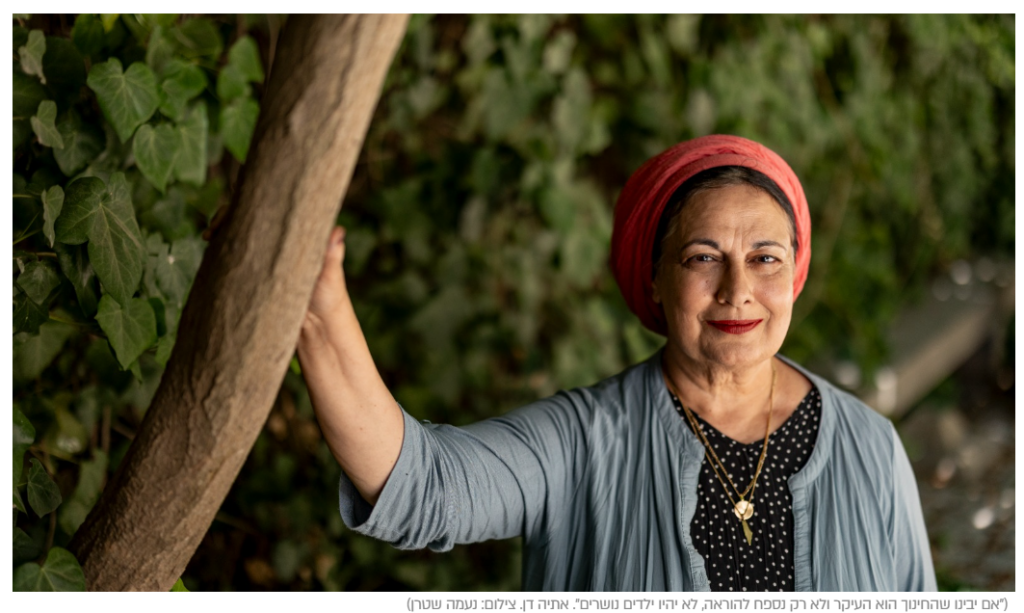
In one of the rooms, I meet Etia Dan, who founded the center as part of Menifa, an organization originally established to prevent young people from dropping out of educational frameworks and which has since developed into a broad educational and therapeutic organization providing holistic support to diverse populations.
Dan is the mother of eleven children. For more than three decades, she has lived in Jerusalem’s Christian Quarter, in the Neot David community, and is married to Mati Dan, head of the Ateret Cohanim organization.
“We Have Lost Sight of What Education Really Means”
The idea for Menifa first took shape twenty-two years ago. At the time, Etia Dan was working as a teacher and lecturer in education while beginning doctoral studies in history. At the same time, she made a deliberate decision to leave the confines of academia and meet young people where they actually were.
On Thursday evenings, she would go to downtown Jerusalem, sit in a pizzeria, and invite teenagers wandering through the area to sit down and talk.
“I didn’t turn it into some kind of youth hangout,” she recalls. “I was simply there, offering a place where someone would listen.”
Word spread about the woman at the pizzeria who was willing to listen, and more and more teenagers began to come. Most of them had already left school. Slowly, through those conversations, Dan came to understand that the education system needed to respond very differently to young people who were disengaging from school.
“I wrote a letter to the Minister of Education saying that we could not leave the children at the margins of the school system without an appropriate response,” she says. “At the time, there were 100,000 identified and documented school dropouts, and the number has only continued to rise. Research suggests that for every young person we know about, there are another two who remain invisible – students who may physically come to school but are not truly learning, and therefore are not counted. At first, I thought the problem lay mainly in teaching methods, so I focused on how the approach to teaching could be changed.”
Following her appeal, Dan received funding from the Ministry of Education to launch a pilot dropout-prevention program. It began at Ginogli High School in Jerusalem, where a dedicated class was established.
The model placed a full-time educator in the classroom who functioned as a mentor – what Menifa came to call a “life teacher” or life mentor – alongside teachers who used alternative instructional methods.
But after many teaching interns had worked with the educational approach she developed, Dan reached a different conclusion: the central problem was not teaching methodology, but education itself.
“A homeroom teacher is given a few additional hours for ‘education,’” she explains, “but no one really asks what that education is supposed to mean. Beginning in the 1970s, educational ideas emerged suggesting that educators no longer had the right to shape children’s values, and that teachers should not really be educators in that sense. Somewhere along the way, we lost our understanding of what education actually is.”
The word “education” itself is almost politically incorrect. It can sound as though the adult is saying: I know what is right, and I will teach it to you.
“You can call the role a coach or a mentor,” Dan says. “The point is that the educator is focused on the child and understands what that child needs. Education, in my view, is about helping a young person develop an identity.”
“So in Menifa classrooms, the first thing we did was place a full-time educator in the class whose job was not to teach academic subjects at all. The role involved intensive personal relationships, developing each child individually, and also developing the group as a group – strengthening its social fabric, setting goals and building a shared sense of purpose. Remarkable things happened simply because we introduced a genuine educational model.”
Alongside her work at Ginogli, Dan also began working with young people in a residential welfare setting. These two experiences ultimately gave rise to Menifa as a formal program.
At the heart of the model were small classes led by an educator whose primary focus was the relationship with the child – listening to the child’s needs, aspirations and difficulties. The educator’s responsibility extended well beyond school hours and included work with both parents and teachers.
Learning relied more heavily on guided independent practice than on frontal teaching, and was combined with extensive social activity.
Over time, however, Dan realized that education alone was not enough. The program also needed to incorporate systemic therapeutic tools, including individual therapy, staff supervision, parental guidance and group therapy.
A turning point came in 2012, when Menifa requested data from the Knesset Research and Information Center regarding the number of children in need of treatment.
“The statistic that shook me,” Dan recalls, “was that out of 170,000 children who needed treatment, only 12 percent were actually receiving it. More than 150,000 children were not receiving help, and many of them would later become the young people identified as dropouts.”
“So the core problem is not that the Ministry of Education does not know how to teach – although teaching can certainly be improved. The deeper issue is that many children are simply not emotionally available for learning.”
“We saw that very clearly in the field. In one program we ran with KKL-JNF to support young people in peripheral communities, there was a boy who was brilliant with computers. He told us, ‘I can’t study when my father is threatening to kill my mother.’”
“In another place, a boy said, ‘Before you give me a computer, first give my mother a bed.’ So we brought his mother a bed. What he was really telling us was that he could not learn while his home situation remained as it was.”
Menifa came to understand that working with young people required a truly holistic approach – one that sees the whole child within the context of family and community.
Over time, Dan developed a Star of David model. The first triangle represented education, functioning and therapy. A second triangle was later added, representing family, educational framework and community.
The family remains central, but the support system must address all dimensions together.
“We try to coordinate everything around the child,” Dan explains, “rather than sending that child to receive fragmented services in different places that do not communicate with one another.”
Equally important, she says, is that everything be done respectfully and at eye level, so that the young person can continue to experience themselves as a normal child or adolescent rather than as someone defined by a problem.
Supporting Soldiers and Youth Living on the Hilltops
The Cherna Center in Jerusalem, where the interview takes place, is one example of this approach.
Most of the girls at the center have experienced psychiatric hospitalization. Yet at the center they study, play music, create art and function as a group.
“They are treated completely normally,” Dan says. “This is not a place run by a psychiatrist, because a psychiatrist is a physician. We run it from an educational-therapeutic perspective.”
“Psychiatry and medication may certainly be necessary, but they need to be integrated into an educational and therapeutic process. It is like saying one shoulder is injured while the other is healthy. Every one of us has parts that are struggling and parts that are healthy. We want to strengthen the healthy part.”
“A young person needs to understand that first and foremost they are whole and healthy, and that there is one part of their life that currently requires treatment. We do not want to define the entire person by an illness. When you work this way, the situation can be understood as a crisis that can pass.”
“That is also why we never established separate Menifa schools. Doing so would risk perpetuating the idea that these young people are somehow second-class. Even in the most difficult case, I have always treated the situation as a temporary crisis, and that is the message we give the child from day one.”
Dan is critical of the lack of community-based rehabilitation services for children and adolescents dealing with mental health challenges.
In her view, Menifa offers a rare integrated model that helps young people rebuild their lives within the community, based on the belief that a person who recovers and becomes independent should not be condemned to lifelong institutional living.
“A girl can arrive here with her wings completely broken and leave as an outstanding student, become a youth movement counselor, continue to National Service – and most importantly, feel that she is a normal young woman.”
Today, Menifa also offers schools programs through Israel’s GEFEN educational system, providing group support and therapeutic work for students selected by school counselors. Group work allows young people to share difficult experiences and creates a sense of normalization that can make coping easier.
At the same time, Menifa’s work has expanded beyond young people formally defined as school dropouts to include disengaged youth who may receive services through municipal youth advancement programs. Here too, Menifa broadens the response beyond academics to include emotional and social support.
The organization’s vision does not end with high school.
More than a decade ago, Menifa won a tender to support lone soldiers and soldiers of Ethiopian origin during their military service. Each soldier in the program is paired with a personal mentor who accompanies them throughout their service – functioning much like an older sibling, strengthening the family support system around them and helping them cope with difficulties in order to prevent them from dropping out of military service.
Dan mentions that later that same day she is due to meet with the IDF’s Personnel Directorate at its request, to discuss the wider challenge of soldiers leaving military service early.
“The head of the Personnel Directorate recently discovered that around 4,000 soldiers drop out every year,” she says. “So I sat down and wrote a working paper on how to create a response for that number of soldiers. The first thing is to believe that it can be done.”
A significant part of Menifa’s early work – and of its work today – takes place among young people living on hilltops in Judea and Samaria, many of whom left formal educational settings.
“Menifa was a kind of insurance policy for these young people,” Dan says. “They knew that even if they left the formal framework, they would still be able to complete their matriculation exams through Menifa.”
Dan says that several technological learning centers are expected to open in Judea and Samaria in the near future, with the aim of providing appropriate educational opportunities for the many young people who have left school and now live in these communities.
“For the first time, people are acknowledging that there are young people who need a different kind of response,” she says. “Placing them automatically in the welfare system is not necessarily right, and a conventional school is not necessarily right for them either.”
“There are many children going through a life journey that is emotionally and psychologically difficult. Sometimes ideology is part of that journey, but ideology too requires guidance – a young person needs help understanding how to develop and express those beliefs responsibly.”
“I believe a child needs a responsible adult. A child needs to be allowed to feel like a child, even if they choose to take on meaningful responsibilities.”
Are There Cases Where You Think There Is No Chance of Success?
Dan answers with the story of a seventeen-year-old girl who once asked to meet her.
“She had heard about us and said she wanted to study. I suggested that she join a class for girls in Jerusalem, and she replied, ‘But I have nowhere to sleep.’”
“She told me that she had escaped from a cult and had suffered extensive abuse. When the story of the cult became public, the children were placed in welfare institutions. She moved from one institution to another and at one point even ended up in prison. By the time I met her, she was homeless and living on the street.”
“My team said to me, ‘This is too much. This girl needs a residential institution. She has nothing, and she has barely studied.’”
“But as the organization’s CEO, I was able to make the decision, and I decided that we would take responsibility for her story.”
“The first thing we did was find a wonderful family who took her in, and she remains in contact with them to this day.”
“She went on to study, complete her matriculation exams and fight for the opportunity to perform meaningful military service despite her very difficult past. She became a career officer, was named an outstanding soldier by the IDF Chief of Staff, and received an award for excellence from the President of Israel.”
“Today, the state’s solution is often to place children like her in welfare institutions, sometimes without creating a truly individualized response for the specific child. We surrounded this girl from every direction, including with financial support.”
Dan is quick to add that not every story becomes an immediate success story. Sometimes, she says, the results of years of investment become visible only much later.
“Since COVID, the Dropout Rate Has Reached 30 Percent”
Dan has a clear and at times sharply critical view of the education system.
In her opinion, a genuine educational response could prevent many of the problems currently associated with dropout. One of her central proposals is that every classroom in Israel have a full-time educator whose role is not academic teaching, but education and mentoring.
“If we understand that education itself is the central task, and not merely an addition to teaching, we will not have children dropping out,” she says. “I truly believe that. Two hundred years ago, yeshivas already had a mashgiach whose job was not to teach academic material.”
Her criticism also extends to school administrators.
“When a school administrator removes a child from school, that administrator often does not take the child by the hand and make sure they enter another framework,” she says.
“Sometimes a school accepts a child wearing a large kippah and sidelocks, and then the day the child cuts off the sidelocks, the principal says, ‘I’m sorry, you no longer belong here. Go home.’”
“My approach is different. I say: whoever you accepted is your responsibility. You cannot abandon that child.”
“A young person who begins to disengage from school does not easily find another place. I think many young people drop out because schools focus more on preserving the institution than on preserving the child. There is always a tension between the two – what are we trying harder to protect?”
“I believe in allowing as much flexibility as possible and not becoming frightened too quickly. I am not saying every behavior is ideal. But the alternative – throwing a child out – is far more serious in my eyes.”
“Once a child is expelled from a framework, deterioration can happen very quickly. Very often rebellion is actually a cry from young people asking to be seen. If we systematically make sure that every child is seen, perhaps they will no longer need to scream.”
Dan also addresses the religious and spiritual dimension of disengagement.
“Many of the young people I have met who were supposedly ‘leaving the path’ were expressing something that cries out to heaven. Their message was: I want to understand who God is for me. I want to understand what faith means in my life.”
“You cannot present God to a thousand children in exactly the same way.”
“Today, I actually see much more faith and spirituality than in the past, even if it does not always look that way externally. The question is how an educational institution speaks with a child who appears to be rebelling – not by focusing on how that child looks, but on who that child is.”
“That is not easy. It demands tremendous inner strength from educators.”
Today, Is Every Child Guaranteed a School That Must Accept Them?
“Yes,” Dan says, “but there is not necessarily real listening to the child’s needs. We do not really try to tailor something specifically for that child.”
“And in general, school principals today have very little time to engage in education because they are overwhelmed by administration.”
“When I was a homeroom teacher, I had three hours a week allocated to educational work, and I had to decide which two or three girls I would focus on.”
“At Menifa, we hold staff meetings and professional supervision specifically to make sure that no child has been overlooked.”
According to Dan, the situation deteriorated significantly after the COVID-19 pandemic.
“Since COVID, the scale of disengagement and dropout has continued to rise, and it is now above 30 percent. This is no longer an issue for the Ministry of Education alone. I believe Israel needs a national authority dedicated to preventing school dropout.”
“This is a massive national crisis, because children who deteriorate now will carry the consequences into their futures and into the families they eventually build.”
“When a young person reaches a crossroads and turns toward unhealthy behaviors – whether drugs and alcohol, depression, or withdrawing into the home and spending all day in front of a computer – the result is enormous difficulty and loneliness.”
“The Ministry of Education cannot simply say that any child who needs treatment should be sent to the welfare system.”
In today’s digital learning environment, Dan believes that schools should devote far more time to social and educational development and somewhat less to frontal instruction.
“Today, a child can open a computer and advance academically,” she says. “But no one learns how to build friendships sitting alone in front of a computer at home. That is why an educational institution needs to focus far more on education in the broader sense.”
That Makes It Sound as Though School Should Become a Summer Camp.
“The word ‘summer camp’ trivializes what we are talking about,” Dan responds. “It makes it sound as though nothing meaningful is happening.”
“Look at the center here today. The girls are sitting together, talking, doing all kinds of things that are developing them as people.”
“I believe that this is one of the central responsibilities of the education system today. A school is first and foremost an educational and social institution.”
“At Menifa, there is a physical place to study, with teachers who prepare students for matriculation exams, but the central emphasis remains educational. Working with young people requires conversation, relationships and inner resources – not imposed discipline.”
Over the years, Dan also came to understand that parents must be an integral part of the process.
Menifa therefore expanded its work in peripheral communities to include programs that actively involve parents, while keeping families regularly updated about their child’s progress.
“With very few exceptions, parents are the people who accompany their child throughout the journey of life,” she says. “So the solution has to include them.”
“They need to be partners all along the way, not brought into the picture only when the child stops functioning.”
“I do not ask who is responsible for the problem. I ask what the solution is. And I have no doubt that parents are part of the solution.”
“They need to remain in ongoing contact with their children. Even if your son or daughter is living on some distant farm, you need to go there. You need to enter their world.”
“Parents – whether we have one child or eleven – are part of their children’s lives. The system must give parents a much greater role.”
“I always tell parents: it does not matter whether you are part of the problem. You are part of the solution, so invest your energy in the solution. There is no point wasting all your strength asking who is to blame and why. You need to remain strong and full of faith.”
“I Learned to Enjoy Life Itself”
Another initiative developed by Dan is Menifa’s mobile Personal CHALOM Unit, whose Hebrew acronym stands for Education for Strengths and Personal Excellence.
“We built it before the war,” Dan says. “The Holy One, Blessed be He, was guiding us.”
The mobile unit offers short-term therapeutic interventions and empowerment workshops, incorporating technological tools such as virtual reality headsets and a computerized strengths questionnaire.
The philosophy behind the initiative is that not everyone requires long-term therapy. Sometimes the most effective intervention is to identify and strengthen what is already healthy and functioning, rather than focusing primarily on deficiencies.
“We originally developed it because children are often assessed through psycho-didactic evaluations that focus on what they are not good at,” Dan explains. “No one asks what they are good at.”
Following the outbreak of the war, the mobile unit expanded its target populations.
“We went to the Shura military base,” she recalls, “and the soldiers who took part in the activity talked for three hours without stopping.”
“We asked them: What is the good thing you are taking from this experience? Because in the end, a person can drown in all the terrible things they have seen.”
“The challenge is to identify the thread that allows you to emerge stronger, and then to strengthen the positive things that happened within the experience.”
“We work with short-term interventions because not everyone needs therapy.”
For Dan, the essential goal is resilience.
“I want a person to be able to stand on their own two feet and not be dependent – not on me, not on a therapist, not on anyone. I want them to know what they want and where they are going.”
How Would You Describe the Process You Yourself Have Gone Through Since Those Early Meetings in the Pizzeria?
“Before Menifa, I do not think I was really doing educational work,” Dan says. “I was a cog in the system.”
“Real educational work requires a completely different way of thinking, and I learned that from the children of Menifa.”
“If you learn to truly listen and to look a child in the eye as an equal human being, you stop being frightened by them.”
“At Menifa, we do not have discipline problems. I think much of the violence and bullying we see comes from a lack of listening. A person feels like an animal trapped in a cage when no one hears them and no one understands what has happened to them.”
“On a personal level,” she adds, “I began studying therapeutic approaches in depth so that I could better understand the world of therapy. I am an educator, not a therapist, but you cannot have these conversations without developing a serious understanding of therapeutic tools.”
“Overall, I would say the biggest change I went through is that I became a manager. I never planned that, but I think I became a good one.”
“At any given moment I have around 200 employees, so that requires planning and constant thought about how to help staff grow, how to give them room to express themselves and how to create change.”
“Today I spend less time directly with the children and more time with teams, partners and government officials.”
“The most important thing is never to stop initiating, never to become rigid. For me, constant initiative means living with uncertainty – moving toward the unknown with tremendous faith in the Holy One, Blessed be He.”
“Faith that good will ultimately prevail, if we allow it to enter.”
Dan continues to dream about new projects, though she admits, with a touch of regret, that she does not always stop long enough to enjoy the fruits of what has already been built.
“It may sound like humility, but it isn’t,” she says. “People need to learn to stop, look around and enjoy the fruits of what they have created – their children, their work, the things they have built.”
“Children need to feel that their parents enjoy them.”
“Not long ago, I went to the pool with my daughters. I am not particularly fond of going to the pool, but they organized it, and they were having such a wonderful time. I learned from that experience that sometimes you simply need to enjoy life.”
“I think those of us who are second-generation Holocaust survivors grew up with a very strong sense of mission and responsibility.”
“For example, I had eleven children because I always felt that this was part of the way the Jewish people would rebuild itself.”
“My children no longer experience life in exactly that way. They know how to enjoy life itself – and that too is an important value.”
Dan recently gathered many of the insights she has accumulated over the years into a book titled Dialogue Between Pain and Hope.
The book documents Menifa’s work, particularly during its first decade, and includes monologues by program graduates who reflect on their experiences years later, as well as testimonies from teachers and partners. At the end of each monologue, Dan offers her own reflections on the process and points for further thought.
“In essence,” Dan concludes, “what we discovered at the very beginning has not changed: we are fundamentally a program for developing motivation.”
“Once a child truly wants to move forward, the sky is the limit.”